
Watch on YouTube (opens on YouTube in a new tab)
Loki and the Theft of Eternal Youth
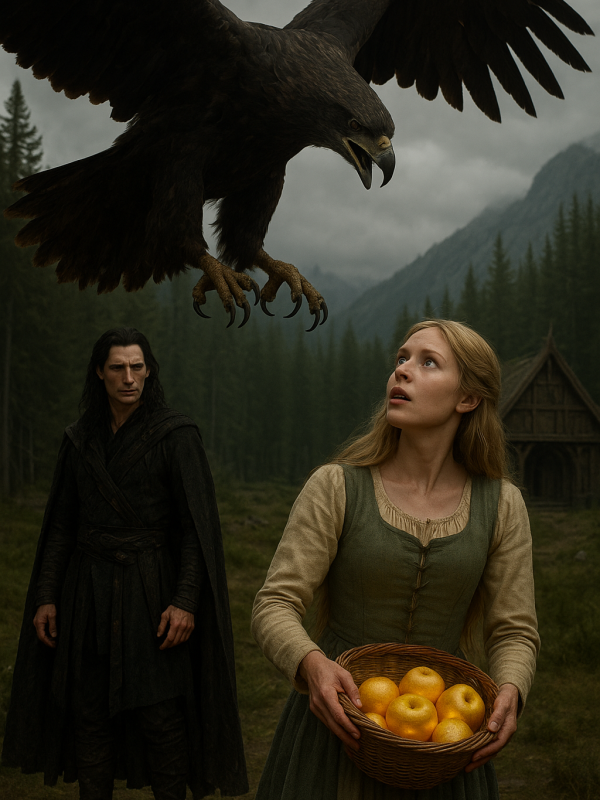
Loki’s role in Norse myth is rarely simple, and the theft of Idunn is one of the clearest examples why. It begins almost by accident: traveling with Odin and Hoenir, Loki strikes at an eagle that has been stealing their meal, only to find his weapon stuck fast and himself dragged across the wilderness. The eagle is the giant Thjazi in disguise, and he offers Loki a bargain for his freedom — lure Idunn, keeper of the golden apples that keep the Norse gods young, outside the walls of Asgard.
Loki agrees, and the consequences are immediate and visible: without Idunn’s apples, the gods themselves begin to age. It is one of the few moments in the mythology where the gods’ own mortality-adjacent vulnerability is put on screen so plainly — their youth was never inherent, it was maintained, and Loki’s bargain broke that maintenance.
True to the shape of most Loki stories, the same cunning that caused the problem is what undoes it. Borrowing Freyja’s falcon form, Loki flies into Thjazi’s realm, transforms Idunn into a nut to carry her home safely, and the gods finish the job by killing Thjazi when he pursues them as an eagle. Idunn and her apples return to Asgard, and the gods reclaim what they’d lost.
Sources & Further Reading
- Prose Edda, "Skáldskaparmál," opening narrative — Bragi's tale to Ægir (trans. Arthur Gilchrist Brodeur, 1916) — Odin, Loki, and Hœnir's journey; the eagle Thjazi; Loki's bargain; Idunn's abduction and rescue
- Note: the skaldic poem "Haustlöng" (Þjóðólfr of Hvinir) is traditionally associated with this myth, but a specific stanza could not be independently verified against a reliable translation in this pass — not cited with invented line numbers.